
Dry-fly fishing is probably one of the aspects of fly fishing that we don't spend nearly enough time doing in South Africa.
Occasionally, we might enjoy a bit of dry-fly fishing for trout on our smaller streams, and even more occasionally for yellowfish on rivers such as the Vaal and Orange. Sterkfontein Dam is, of course, well known for its excellent dry-fly fishing. However, outside of these venues, dry-fly fishing is not something we practice all that often in this country.
Choosing the right dry fly can be difficult. For me, the most important consideration when selecting a dry fly is visibility.
How often do we cast a dry fly onto a stream or river, only for it to disappear from sight? We can't see where it is, detect a take or properly control our drift. If you cannot see your fly, managing your presentation and detecting those subtle takes becomes extremely difficult.
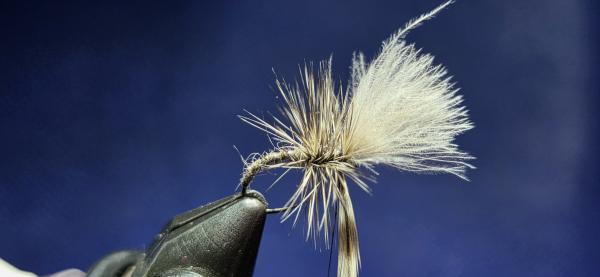
With this in mind, I've developed a fly that I particularly enjoy fishing. I've called it the AdamFink Fly.
It works exceptionally well for trout on smaller streams and can be tied in a variety of sizes. It is also very effective for yellowfish, and we've caught carp, bass and several other species on it as well.
The primary characteristic of this fly is its visibility.
Over the years, we've had several excellent dry-fly patterns, each with its own particular characteristics. The CDC & Elk, for example, is an extremely visible fly that can be spotted from a considerable distance. Other well-known patterns include the Adams, the Klinkhammer and the various Hi-Vis patterns.
All of these flies are excellent fish catchers, but the AdamFink Fly combines several of their most useful characteristics.
First and foremost, visibility. The CDC provides an excellent visual target, making the fly easy to follow, regardless of your presentation or how far you've cast it. Being able to see your fly makes detecting fish takes considerably easier.
The CDC also adds buoyancy, but the fly needs a little more flotation to sit properly on the water. That is where the hackle comes in. As on the Adams, it holds the fly high on the surface, keeping it visible to the angler and natural-looking to the fish.
Another important feature is the body design, which takes inspiration from the Klinkhammer.
One of the things I've always liked about the Klinkhammer is the way it sits under and on top of the surface film, breaking through the water in a manner that resembles an emerging insect. To me, an emerger is an insect making that transition from the water into the air, and the AdamFink Fly incorporates this characteristic in its design.
The body section is very similar in concept to that of a Klinkhammer, allowing the fly to sit in the surface film while presenting an attractive profile to feeding fish under the surface.
The AdamFink Fly is therefore a combination of visibility, flotation and an emerger-style presentation.
It can be fished as a conventional dry fly, or you can suspend a nymph or another fly beneath it as a dropper. Because of its excellent visibility, it also makes a very effective strike indicator. You can follow the fly on the water and detect those takes that might otherwise go unnoticed.
Yellowfish on dry flies in the Vaal River is something we probably don't do nearly often enough.
One of the reasons may be that the best opportunities are often accessed by boat. Having a boat allows you to reach those productive tailouts and stretches of river that can be difficult to access from the bank and wading to them in winter is not particularly pleasant with the water being so cold
During the winter months, particularly August and September, before the summer rains arrive, these areas can offer some fantastic dry-fly opportunities.
The important thing is to look for tailouts where the current is moving steadily. You may also find feeding fish in flatter, more open stretches of water, but there must still be some movement in the water. The rises often present themselves as what looks like a tiny insect hatching. They are not always splashy rises or visible sipping.
In fact, on the Vaal this weekend, I spotted some excellent rising fish that would have been ideal candidates for dry-fly fishing. The water was still clear enough to make these conditions particularly appealing. There were massive hatches of small brown caddis fly.
Dry-fly fishing for yellowfish can be a fantastic experience, and we should be doing it far more often.
At the end of the day, a dry fly is only as useful to the angler as our ability to see it, follow its drift and detect the take.
And that's exactly what the Adam Fink Fly is designed to do.
Materials for the AdamFink.
Hook of your choice. I prefer a wide gape, like the hooks normally used for tying Klinkhammers.
4 CDC feathers of a light visible colour.
24/0 Semperfli cotton black or white.
Fine hare’s ear dubbing.
Thin UV blue or pearl flash.
Suitable grizzly dry fly hackle.
Step 1
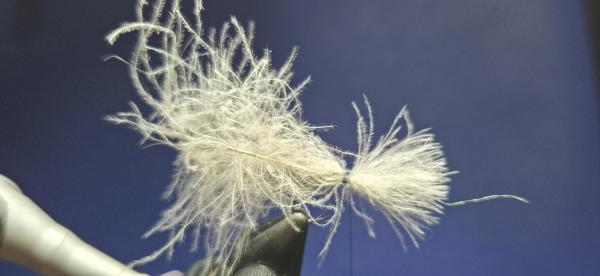
Place CDC feathers together and tie down leaving a bit of space between eye of hook and trapping feathers down. Trap feathers and secure then clip butt sections off.
Step 2
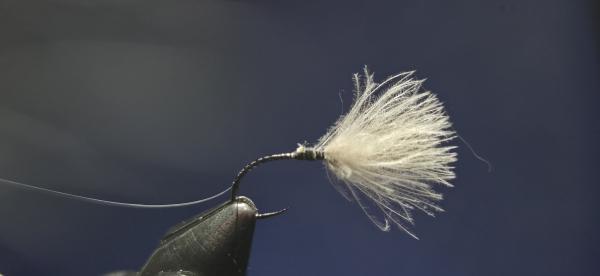
Add the UV in and trap it down to the back of the fly where the body will start.
Step 3
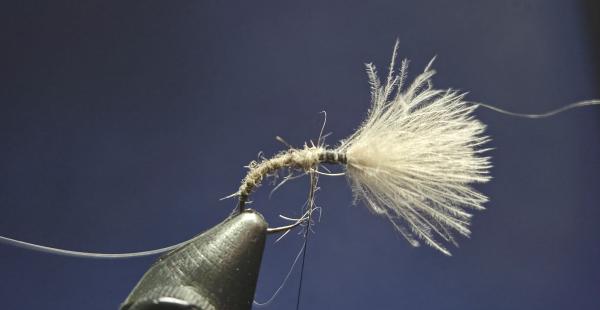
Take your hare’s ear dubbing and dub the shank towards the CDC leaving enough space for the hackle.

Step 4
Wind the UV flash up to the finishing point of the dubbing in evenly spaced turns and trap down. The choice of making this fly with a rough body or a smooth aesthetically pleasing body is entirely your own choice.
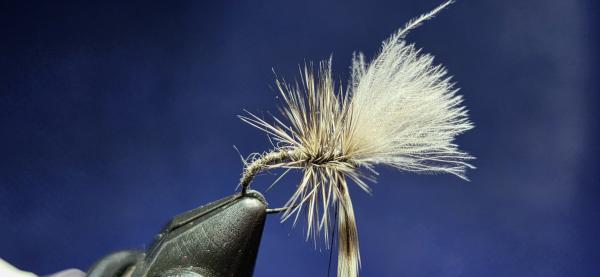
Step 5
Tie in the hackle in the space you left between the body and the CDC. You can hackle heavily or sparsely, depending on your fishing conditions.
Tie off and the fly is ready to fish. I am inclined to wrap the cotton through the hackle and then Tie off for extra durability. Especially so because you can catch many fish on just one fly.
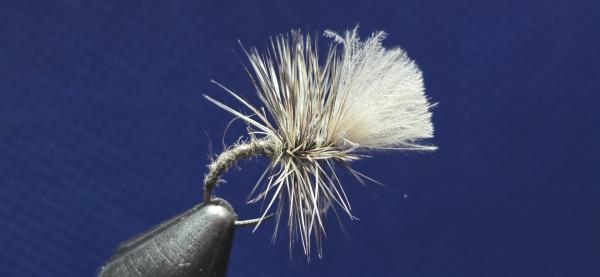
Step 6
If you like you can trim the CDC eventually to length you require at this point.
Return to News

